
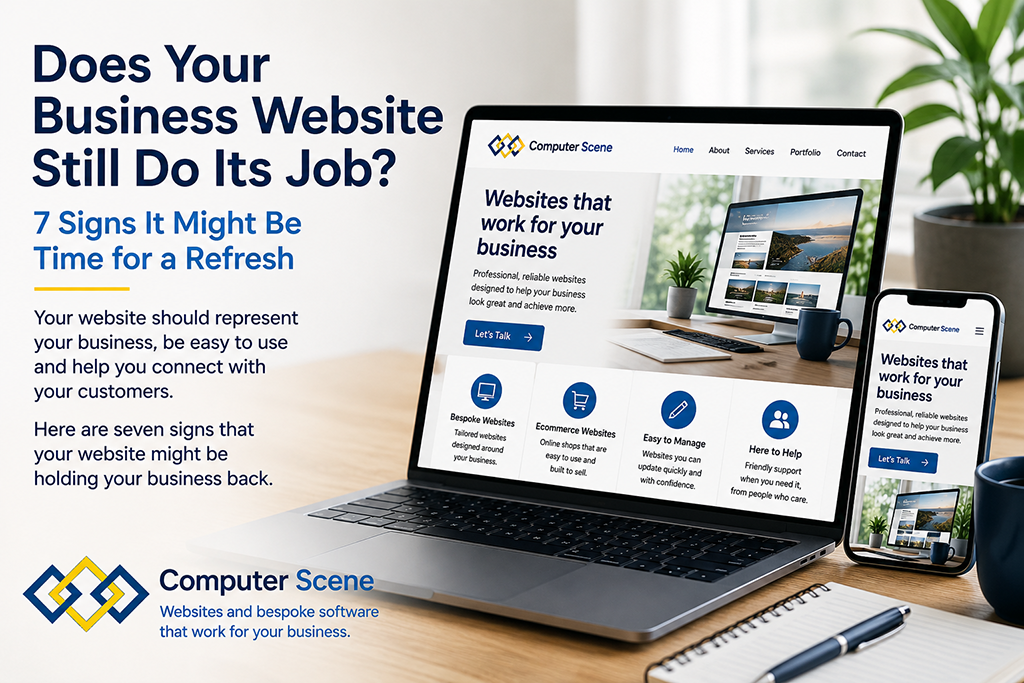
Does Your Website Still Do Its Job? Here are 7 Signs It Might Be time for A Refresh Introduction Having a website is one thing. Having a website that still represents your business properly is another. Businesses change over time. You might offer different services, sell different products or deal with a completely different type of customer than you did when your website was first built. The problem is that websites don’t always change with the business. So how do you know when your website could do with some attention? Here are seven signs worth looking out for. 1. Your website no longer reflects your business This is probably the biggest one. Take a look at your website as though you’re a potential customer seeing your business for the first time. Does it accurately explain what you do today? Services get added, products change, businesses move and priorities evolve. If your website is still talking about things that were important five years ago, it may no longer be giving customers the right impression. 2. It doesn’t work well on a mobile More and more people will see your website on a phone rather than sitting in front of a desktop computer. That means your website needs to be easy to use on a smaller screen. Text should be readable, buttons should be easy to tap and visitors shouldn’t have to zoom in or move the page from side to side just to find what they’re looking for. Try using your own website on your phone. If you find it frustrating, there’s a good chance your customers do too. 3. Customers struggle to find the important information A visitor shouldn’t have to hunt around your website to find out what you do, how to contact you or how to buy from you. Good website design isn’t about filling every available space. It’s about making the important things easy to find. Sometimes a website has simply grown over the years, with new pages and sections added as they’re needed. Eventually, the structure can become confusing. A refresh can be an opportunity to simplify things and make the whole site easier to use. 4. The design no longer represents your business Website design changes, but that doesn’t mean you need to rebuild your site every time a new design trend appears. What matters is whether your website still looks professional and appropriate for your business. If you’ve updated your branding, changed your logo or simply grown considerably since the website was created, the site may no longer give the impression you want customers to have. 5. Making simple changes has become difficult Updating your opening hours or changing a paragraph shouldn’t turn into a major project. If every small alteration requires a workaround, or you’re worried that changing one thing might break something else, the website may have become unnecessarily difficult to manage. A modern website should make routine updates straightforward. 6. Your ecommerce website makes buying harder than it should be For an ecommerce business, the website isn’t just there to provide information — it’s your shop. Customers should be able to browse products, understand their options, add something to their basket and complete their purchase without unnecessary complications. If customers regularly call because they can’t find a product, don’t understand the available options or aren’t sure how to order, it may be worth looking at whether the website itself is getting in their way. 7. You’re reluctant to send people to your website This is a surprisingly useful test. When somebody asks about your business, are you happy to say, “Have a look at our website”? Or do you find yourself explaining that some of the information is out of date, a particular page doesn’t work very well or that they should ignore certain parts of it? Your website should be something you’re comfortable putting in front of a prospective customer. Does an old website automatically need replacing? No. A website doesn’t need replacing simply because it’s a few years old. If it still represents your business well, works properly on phones and computers, is easy to navigate and does what you need it to do, there may be absolutely no reason to start again. Equally, there comes a point where continually altering an older website isn’t necessarily the best answer. Sometimes a refresh is enough. Sometimes rebuilding gives you a better foundation for what the business needs today. The important thing is deciding what’s right for the business rather than replacing a website simply for the sake of having something new. Thinking about your business website? Computer Scene has been working with businesses for over 30 years. We design and build business websites and ecommerce websites, taking the time to understand what the business actually needs rather than trying to fit every customer into the same template. We’re based in Bury St Edmunds and work with businesses across Suffolk and the surrounding area, including Newmarket, Mildenhall, Red Lodge and Ipswich. If you’re wondering whether your existing website could do with a refresh, or you’re considering a completely new website, we’re always happy to have an initial chat. Call us on 01638 563342
5 Signs Your Business Needs Bespoke Software
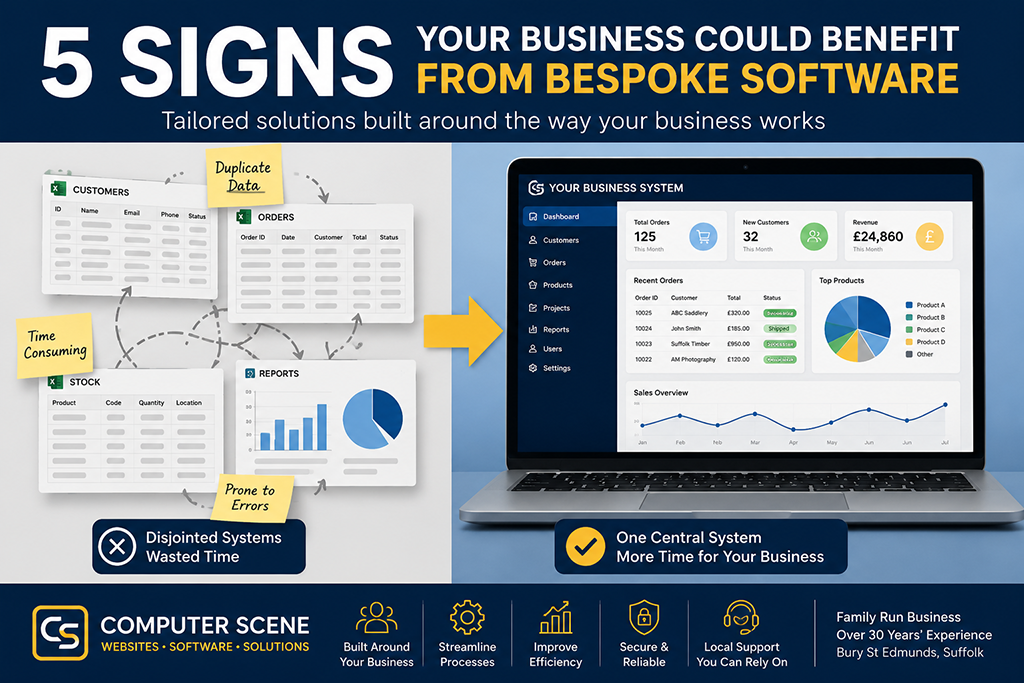
5 Signs Your Business Needs Bespoke Software News & Advice Introduction Every business works differently. As your business grows, you may find that the software and systems you once relied on no longer work as efficiently as they used to. Perhaps you’re managing information across several spreadsheets, entering the same details into different systems or spending valuable time carrying out repetitive tasks manually. Off-the-shelf software can be a great solution for many businesses, but sometimes your business processes simply don’t fit neatly into a standard package. That’s when bespoke software could be worth considering. Here are five signs that your business may have reached that point. 1. You’re Relying Heavily on Spreadsheets Spreadsheets are incredibly useful, but as a business grows they can become increasingly difficult to manage. You may have multiple spreadsheets containing similar information, different versions being passed between members of staff or complicated formulas that only one person understands. A bespoke system can bring this information together into one central application, making it easier for your team to access, update and manage the information they need. 2. You’re Entering the Same Information More Than Once Do you find yourself entering customer, order, stock or project information into one system and then entering the same details somewhere else? Apart from taking up valuable time, repeatedly entering the same information increases the possibility of mistakes. Depending on the systems you’re using, bespoke software can help streamline these processes and reduce unnecessary duplication. 3. Repetitive Administration Is Taking Up Too Much Time Small administrative tasks don’t always seem significant individually. But if several employees are carrying out the same repetitive processes every day, the amount of time being lost can quickly add up. This could include producing documents, updating records, processing enquiries, creating reports or moving information between different systems. The right software can automate or simplify many of these processes, allowing your team to spend more time on the work that really matters to your business. 4. You’re Changing the Way You Work to Suit Your Software This is one of the biggest warning signs. Software should support the way your business operates — your business shouldn’t have to change the way it operates simply to accommodate the software. Off-the-shelf applications are designed to work for thousands of different businesses, which inevitably means compromises. With bespoke software, the starting point is different. We look at how your business actually works and develop a solution around your requirements. 5. Your Existing Systems Can’t Keep Up With Your Business The systems that worked perfectly when your business was smaller may not necessarily be suitable as you grow. You might have more customers, more employees, more products or simply more information to manage. Rather than continuing to add temporary workarounds, it may be time to consider a system that’s designed around the way your business operates today while also taking future requirements into account. What Does Bespoke Software Actually Mean? Bespoke software doesn’t necessarily mean an enormous, complicated system. It could be a: Customer or staff portal Booking system Business management application Stock or order management system Customer database Quotation system Reporting application Workflow management system Integration between existing systems The important difference is that the software is developed around your requirements and your business processes rather than expecting you to adapt your business to fit a standard package. Not Sure Whether You Need Bespoke Software? You don’t need to know the technical answer before speaking to us. That’s our job. Computer Scene is a family-run business with over 30 years’ experience in website and software development. We’ll take the time to understand how your business currently works, the problems you’re experiencing and what you’re trying to achieve. We’ll then discuss the options with you in plain English, without unnecessary technical jargon. If an existing solution is appropriate, we’ll tell you. If bespoke development would provide a better solution, we can discuss what would be involved and how we could approach the project. Our initial consultation is free and there’s no obligation. Lets Discuss Your Requirements | If your business is based in Bury St Edmunds, Ipswich, Newmarket, Mildenhall, Red Lodge, Thetford or the surrounding areas and you’d like to find out whether bespoke software could help your business work more efficiently, we’d be happy to have an initial conversation. Get In Touch